During that long, hard, cold winter, it was easy to forget about how fast and how thickly things turn green up here. Winter ended only a few weeks ago, it seems, and now summer is coming on like a steam locomotive rushing into the station as if to make up time. I've been mowing and sowing and weeding and feeding and every so often standing back to look at spring busting out all over, as if it had to get out of the way of summer before it comes piling in.
On the east side of our house the firepinks -- a spectacular little bright-red wildflower -- have come on the strongest we've ever seen. The flame azaleas are astonishingly bright, and on the road down to the barn the lane is lined with big pink rhododendren blooms. The laurels are just now beginning to show their white lacy blooms and the irises have shot up and overflowed with purple blossoms.
Longtime residents up here see this kind of thing all the time, and may be used to the sights. But for me, a city boy who spent as much time as I could outdoors and out in the country when I could, it's still new. The other day I found the first arrowhead I can recall. It was a reddish piece of something, unmistakable shaped as a projectile point, lying there in the dirt not 50 feet from where I picked up a stone ax head a few years ago. My father-in-law had found arrowheads on the property in the same place, and my father as a boy had found a handful of arrowheads in Guilford County as well, but in more than 60 years of looking, this was my first.
Then yesterday, coming down the driveway from the mailbox, Diesel engine roaring, I flushed out two bluebirds -- bright blue and rusty orange slashes jetting out of the hay -- from the nearby field where the grass is getting waist-deep, and seconds after that I flushed out two turkeys, both of which took wing over my head and into sanctuary of the woods. It was a heart-pounder. Where else are you going to get a show like that?
Thursday, May 29, 2014


Thursday, May 15, 2014
Watching magic made in the sound studio
Wood Allen never mentioned the topic to me, nor I to him. But except for getting together and picking every now and then, it was looking like the days of The Villagers were over. We still mourn the loss of boyhood friends Fred Birdsong and Jimmy "Squirrel" Garrison. Fred, who could carry on an intelligent and informative conversation on any topic, died in an awful accident when his car was hit by a drunk driver while Fred was returning from a prison ministry meeting where he counseled and prayed with inmates. Jimmy, who had put off going to the doctor for too long so he could play at my daughter's wedding a decade ago, put up the hardest fight against cancer I ever saw in a human being. He wore that cancer out a number of times, but it kept creeping back. After losing our friends and playing one final duet at Jimmy's son's wedding, Wood and I probably both wondered if there'd be another performance, or any more of those long-slow whiskey-sippin' afternoons picking out old standards like "Abilene" and "Delia's Gone" and "Chilly Winds." Without Fred's banjo and Jimmy's style of Merle Travis picking, it was hard to even think about going back before a crowd.
Then last fall Wood saw that the Kingston Trio https://www.facebook.com/kingstontrio was seeking submissions from songwriters for a second album of new songs written by people who liked to play what used to be known as folk music and may be more widely known now as Americana. Wood had an idea: "You write the words and I'll write the music." I'd tried to write a song a couple times before, but got nowhere. This time, though, Wood suggested writing about sailing, and after a few false starts and a little consultation, I came up with enough for four verses, refrains, a chorus, a bridge and a coda. That's a fancy way of saying it looked like a song, and Wood got on the Martin guitar, figured out a melody, smoothed out a few rough spots and sent me a demo. It sounded great. He sent it in, and astonishingly, it got picked for recording by the new Kingston Trio's George Grove, Bill Zorn and Rick Dougherty.
Wood and I flew out to Phoenix and spent an amazing week in John Wroble's Porcupine Studios in Chandler, AZ as the Trio, with original K3 star and now owner Bob Shane watching most days, recorded our song and that of four others -- Tom Craig from Scotland, Mike Murray from Portland, OR, George Weissinger from Long Island, NY, and Dan Yount from Tuscon and originally from Michigan. Tom wrote a tribute to the great songwriter and performer John Stewart; George did a memorable piece about having the chance to live life again, Dan wrote an ode to Lake Michigan and Mike wrote a riveting piece about snake handling that gives me high-lonesome chills. Here's a photo of John Wroble at the big control board:
These songs will be on an album that may be released late this year after recording 7 more songs from others who sent in submissions. While we've got copies of the rough tracks of our song, none of them has been mixed yet, so they won't be released until later. We also met Paul Gabrielson, the Trio's fine bassist, and Gaylan Taylor, who plays with the Limelighters and who sat in on these sessions to play rhythm guitar. Here's a photo of Wood warming up just before recording a picking track for our song, "On the Wind."
One night we jammed with the other writers as well as folks like businessman Bert Williams, who has attended the K3's fantasy camps and who shelled out the big bucks for a wrap party the last night, and Rick Dougherty, who in his long career has managed opera companies as well as sung with the Limelighters before joining the Trio. Here's a pix from that, with my shiny new Blueridge tenor guitar. Since I live in the Blue Ridge Mountains, I thought it appropriate to get it just before we went out west, even if it does spell Blue Ridge as one word.
Bobbie Childress, Bob Shane's wife, who handles much of the Kingston Trio's business operations as well as The Kingston Trio store, worked with Wood to put a few things musical up on the Kingston Trio's website You might get a kick out of these: http://www.kingstontrio.com/html/kt_news.htm Hint: click on the word "click" when you get to the line reading "Here are some photos & videos uploaded by Wood Allen: click"
 |
| Jack, Wood and Jim on a good night in Buncombe County, 2004 |
Then last fall Wood saw that the Kingston Trio https://www.facebook.com/kingstontrio was seeking submissions from songwriters for a second album of new songs written by people who liked to play what used to be known as folk music and may be more widely known now as Americana. Wood had an idea: "You write the words and I'll write the music." I'd tried to write a song a couple times before, but got nowhere. This time, though, Wood suggested writing about sailing, and after a few false starts and a little consultation, I came up with enough for four verses, refrains, a chorus, a bridge and a coda. That's a fancy way of saying it looked like a song, and Wood got on the Martin guitar, figured out a melody, smoothed out a few rough spots and sent me a demo. It sounded great. He sent it in, and astonishingly, it got picked for recording by the new Kingston Trio's George Grove, Bill Zorn and Rick Dougherty.
Wood and I flew out to Phoenix and spent an amazing week in John Wroble's Porcupine Studios in Chandler, AZ as the Trio, with original K3 star and now owner Bob Shane watching most days, recorded our song and that of four others -- Tom Craig from Scotland, Mike Murray from Portland, OR, George Weissinger from Long Island, NY, and Dan Yount from Tuscon and originally from Michigan. Tom wrote a tribute to the great songwriter and performer John Stewart; George did a memorable piece about having the chance to live life again, Dan wrote an ode to Lake Michigan and Mike wrote a riveting piece about snake handling that gives me high-lonesome chills. Here's a photo of John Wroble at the big control board:
 |
| John Wroble, master of the big board |
These songs will be on an album that may be released late this year after recording 7 more songs from others who sent in submissions. While we've got copies of the rough tracks of our song, none of them has been mixed yet, so they won't be released until later. We also met Paul Gabrielson, the Trio's fine bassist, and Gaylan Taylor, who plays with the Limelighters and who sat in on these sessions to play rhythm guitar. Here's a photo of Wood warming up just before recording a picking track for our song, "On the Wind."
 |
| Wood Allen, about to record at Porcupine Studios, Chandler AZ |
One night we jammed with the other writers as well as folks like businessman Bert Williams, who has attended the K3's fantasy camps and who shelled out the big bucks for a wrap party the last night, and Rick Dougherty, who in his long career has managed opera companies as well as sung with the Limelighters before joining the Trio. Here's a pix from that, with my shiny new Blueridge tenor guitar. Since I live in the Blue Ridge Mountains, I thought it appropriate to get it just before we went out west, even if it does spell Blue Ridge as one word.
 |
| Jamming on the tenor gitbox with Bert Williams, left, and Tom Craig, right |
Bobbie Childress, Bob Shane's wife, who handles much of the Kingston Trio's business operations as well as The Kingston Trio store, worked with Wood to put a few things musical up on the Kingston Trio's website You might get a kick out of these: http://www.kingstontrio.com/html/kt_news.htm Hint: click on the word "click" when you get to the line reading "Here are some photos & videos uploaded by Wood Allen: click"
The lightest moment came at midweek after several days of hard work recording track after track, working to get things just right. George Grove, the great singer and masterful picker on banjo and guitar, had kept the tension down with various antics, including a stray chicken cluck every now and then on a bad take. Since several folks were still to arrive at that point, we did one chorus of George Weissinger's song with our interpretation of chickens clucking the choral melody. You can access this by clicking on "McClucker" on the K3 Facebook website at https://www.facebook.com/kingstontrio John Wroble dubbed that fowl thing in midway through the song, and when it was played back for the unsuspecting, the double-take-whiplash-bugeyed-stupefactional hysteria level was pretty near a 10. You'll have to wait for the release of the CD to hear George's fine song.
Quite apart from their music and their singing and their place in American music history, the think about the Kingston Trio that I think sets them apart is this: They're a bunch of nice guys who make themselves accessible to fans after concerts and who are, in my book, friendly, engaging, creative, welcoming and just happy to have a beer or swap jokes or go for pizza or tell tall tales as anyone you would ever want to meet. When they'd end a concert, they'd say something like, "Look, we're going to go across the street to the lobby of the hotel and have a few. Join us if you can."
Monday, April 28, 2014
Remaking a Southern Appalachian Icon, Chapter 7: Finishing Touches
Working in historic preservation must be a little like waging war: You make the best plans you can, do as much advance work as is possible, and then deal with all the changes that adverse weather, unforeseen circumstances, material problems and unexpected consequences can bring about. So it has been with the Blue Ridge Parkway's renovation of the waterwheel at its highly popular Mabry Mill facility near the Floyd-Patrick County line near Milepost 176: A lot of things have gone right, a few things have gone wrong, there's still work to be done -- but it's looking good.
Here's how things stood at the end of last week, when a thunderstorm that sounded like cannons booming over the ridge brought an early end to the workday. You can see that the 16-foot waterwheel has all new buckets (48 of 'em), and all new fascia boards adorn the outsides of the wheel and new support blocks hold up the outside end of the waterwheel axle.

But there were some unanticipated problems. Early on, Parkway workers removed one of the 16 old arc-shaped facia boards from the wheel to use as a pattern in cutting new white oak board at the Historic Preservation Shop in Sandy Flats, near Blowing Rock. It was a great idea. Jack Trivett and Steve Marmie came up with some woodworking jigs that made it relatively easy to run the inside and outside arcs through bandsaws. Workers could get a lot of work out of the way before driving up to Mabry Mill. And because the arc came off the wheel, it would be a perfect fit. "No doubt in my mind that it would be exactly right," remarked Marmie. "Just no doubt about it."
Except it wasn't a perfect fit. The old arc didn't quite fit the wheel. It didn't look bad from 100 feet, but the closer you got, you could see it has a flaw -- almost a flat place where there should have been a smooth, continuous arc of a circle. "We're perfectionists," mused Trivett. "If we're going to do something, we're going to do it right." It was more than a point of pride with these men. They just don't believe in doing something the wrong way and then walking away without fixing it.
The solution, since most of the material cut from the white oak had been used up, was to go back up in the E.B. Jeffress Park, haul out another 8-foot or so section of that tree, carry it back to the sawmill and get new sections from which to cut a better arc. But this time the craftsmen would bring the large planks to Mabry Mill so they could scribe the exact arc needed for each section and cut it on site -- custom fitting each one, in effect. Here's Trivett working on the inside arc, using a circular saw, taking a little more wood out of the kerf on each pass as he increased the depth of the blade. Using any other kind of saw would not have given the same smooth shape to the cut.

And here Marmie hammers a galvanized nail into the lower end of an arc section.

There were other things to deal with. When the new waterbuckets were assembled on the wheel a few weeks ago, they were butted tightly to one another. But the water flume repairs were not complete, it didn't rain a whole lot, and the green-cut white oak began to dry out and shrink. The water buckets wouldn't hold water as well as planned, and Parkway workers made replacement pieces for some cracked parts and more backing boards for each leaking seam.

All this took a lot of time, and by then the weather wasn't cooperating. It reduced the time available to haul the finishing trim strips out of the creek where they had been soaking to keep them supple. That way they wouldn't split or snap when it came time to clamp them in place and drive their fasteners to give the inside and outsides of the wheel a finished look as well as adding strength to bucket joints.
Though most of the restoration work is done, it may be a race against the calendar. Thunderstorms are in the forecast for all week, and the Mabry Mill gift shop and restaurant -- a favorite place to dine for local residents as well as Parkway travelers who come from hundreds of miles away to eat there -- is to open on Thursday May 1. Still, the old mill is looking good, and it shouldn't take long to do what is left to be done -- if only the weather will cooperate a bit.
 |
| Photos by Jack Betts, Rocky Knob Writery LLC |
Here's how things stood at the end of last week, when a thunderstorm that sounded like cannons booming over the ridge brought an early end to the workday. You can see that the 16-foot waterwheel has all new buckets (48 of 'em), and all new fascia boards adorn the outsides of the wheel and new support blocks hold up the outside end of the waterwheel axle.
But there were some unanticipated problems. Early on, Parkway workers removed one of the 16 old arc-shaped facia boards from the wheel to use as a pattern in cutting new white oak board at the Historic Preservation Shop in Sandy Flats, near Blowing Rock. It was a great idea. Jack Trivett and Steve Marmie came up with some woodworking jigs that made it relatively easy to run the inside and outside arcs through bandsaws. Workers could get a lot of work out of the way before driving up to Mabry Mill. And because the arc came off the wheel, it would be a perfect fit. "No doubt in my mind that it would be exactly right," remarked Marmie. "Just no doubt about it."
Except it wasn't a perfect fit. The old arc didn't quite fit the wheel. It didn't look bad from 100 feet, but the closer you got, you could see it has a flaw -- almost a flat place where there should have been a smooth, continuous arc of a circle. "We're perfectionists," mused Trivett. "If we're going to do something, we're going to do it right." It was more than a point of pride with these men. They just don't believe in doing something the wrong way and then walking away without fixing it.
The solution, since most of the material cut from the white oak had been used up, was to go back up in the E.B. Jeffress Park, haul out another 8-foot or so section of that tree, carry it back to the sawmill and get new sections from which to cut a better arc. But this time the craftsmen would bring the large planks to Mabry Mill so they could scribe the exact arc needed for each section and cut it on site -- custom fitting each one, in effect. Here's Trivett working on the inside arc, using a circular saw, taking a little more wood out of the kerf on each pass as he increased the depth of the blade. Using any other kind of saw would not have given the same smooth shape to the cut.
And here Marmie hammers a galvanized nail into the lower end of an arc section.
There were other things to deal with. When the new waterbuckets were assembled on the wheel a few weeks ago, they were butted tightly to one another. But the water flume repairs were not complete, it didn't rain a whole lot, and the green-cut white oak began to dry out and shrink. The water buckets wouldn't hold water as well as planned, and Parkway workers made replacement pieces for some cracked parts and more backing boards for each leaking seam.
All this took a lot of time, and by then the weather wasn't cooperating. It reduced the time available to haul the finishing trim strips out of the creek where they had been soaking to keep them supple. That way they wouldn't split or snap when it came time to clamp them in place and drive their fasteners to give the inside and outsides of the wheel a finished look as well as adding strength to bucket joints.
Though most of the restoration work is done, it may be a race against the calendar. Thunderstorms are in the forecast for all week, and the Mabry Mill gift shop and restaurant -- a favorite place to dine for local residents as well as Parkway travelers who come from hundreds of miles away to eat there -- is to open on Thursday May 1. Still, the old mill is looking good, and it shouldn't take long to do what is left to be done -- if only the weather will cooperate a bit.
Wednesday, April 9, 2014
Renovating a Southern Appalachian icon, Chapter 6: The Blocks
From a couple hundred feet away on the Blue Ridge Parkway, Mabry Mill looked just perfect for two decades -- an old but handsomely kept grist mill in a gorgeous setting, the waterwheel reflected in a nicely shaped pond and the board-and-batten siding mirroring just the sort of construction techniques used for generations.
But then you walked up closer to the mill, and you could see the deterioration -- the crumbling buckets around the wheel, the broken flume, the nonexistent backing board behind the buckets. All of them were fixed in the last few weeks of March and the first days of April, thanks to hard work, skill and plain old American ingenuity by Parkway workers, and financial help from the Blue Ridge Parkway Foundation. But what about those awful looking blocks holding up the outboard end of the heavy octagonal axle that carries the weight of the waterwheel? Some of those blocks were just eaten up with heavy weather and hard use. How would they be replaced if the waterwheel was to remain on its axle?

The lower blocks needed to fit over carefully laid stones that have been holding axle blocks -- similar to the pillow blocks that machinists use to hold bearings -- for a half century or more. That involved cutting out a good bit of wood and then smoothing off the surface.
Jack Trivett had used a pair of hydraulic jacks to gently raise the axle just enough to take pressure off the blocks and ease them out. There were still obstacles, including 1/2 inch rods that were driven into the wood to keep the blocks from shifting. The only way to get some of them out was to use a wedge and split away the middle layer of blocks.
The second middle block slid in with a bit of coaxing and gently the jacks were eased.

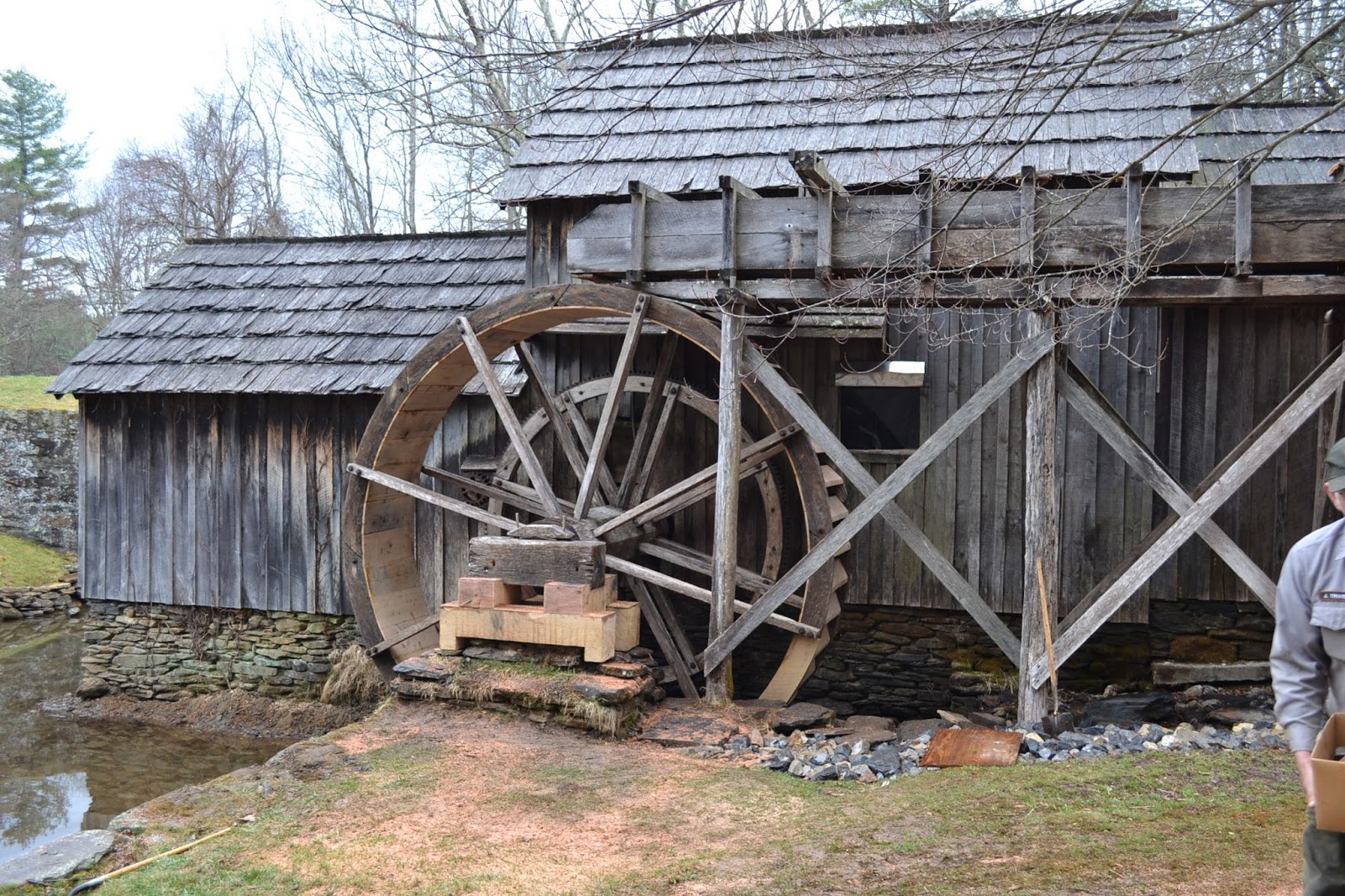
There still is work to do, such as fixing some buckets, putting on thin finishing strips soaking in a nearby creek to keep them pliable, and putting on new facing boards on the wheel that had to be recut. But as this picture shows, the project is nearly finished, and the new buckets and blocks provide a sharper image for the reflecting pond to show visitors as they drive along America's favorite ride.

Next on Rocky Knob Blog, Chapter 7: Finishing touches
But then you walked up closer to the mill, and you could see the deterioration -- the crumbling buckets around the wheel, the broken flume, the nonexistent backing board behind the buckets. All of them were fixed in the last few weeks of March and the first days of April, thanks to hard work, skill and plain old American ingenuity by Parkway workers, and financial help from the Blue Ridge Parkway Foundation. But what about those awful looking blocks holding up the outboard end of the heavy octagonal axle that carries the weight of the waterwheel? Some of those blocks were just eaten up with heavy weather and hard use. How would they be replaced if the waterwheel was to remain on its axle?
 |
| Photos by Jack Betts, Rocky Knob Writery LLC |
In Chapter 5 of this series you read about how many of the components of this project came from a 500-year-old white oak that had fallen several years ago in the E.B. Jeffress Park down the Parkway. That included the big 12-inch-square blocks that would replace the pillow blocks. These blocks sat on the hillside under a stack of bucket components for several weeks while the wheel itself was being rebuilt. There's still work to do on them, including tinkering with several leaky buckets, but new material would have to be cut. It was time start shaping these blocks to the peculiar dimensions and angles for the replacement blocks.
The lower blocks needed to fit over carefully laid stones that have been holding axle blocks -- similar to the pillow blocks that machinists use to hold bearings -- for a half century or more. That involved cutting out a good bit of wood and then smoothing off the surface.
 |
| David Weeks, left, and David Cannaday measure the big saw's depth for cutting out excess wood |
 |
| Jack Trivett uses a sharp axe to smooth the surface |
 |
| One of two finished blocks for the base |
Jack Trivett had used a pair of hydraulic jacks to gently raise the axle just enough to take pressure off the blocks and ease them out. There were still obstacles, including 1/2 inch rods that were driven into the wood to keep the blocks from shifting. The only way to get some of them out was to use a wedge and split away the middle layer of blocks.
 |
| David Cannaday nibbles away at a middle block |
 |
| Workers manhandle the rear lower block into place, gingerly avoiding upsetting the hydraulic jacks |
 |
| With the two lower blocks in place, workers bring in the new middle-level blocks |
The second middle block slid in with a bit of coaxing and gently the jacks were eased.
 |
| Jack Trivett removes the next to last jack as the whole rig settles into place |
And within just a few hours of starting this sometimes-nailbiting experience -- how often do you jack up a waterwheel and put your hands beneath thousands of pounds of heavy blocks to fix something? And how often do you want to? -- the new blocks were in, the axle sitting tight and level, the tolerances close enough to make everyone happy and the jury-rigged brakes on the waterwheel released. And it wasn't even lunchtime yet.
There still is work to do, such as fixing some buckets, putting on thin finishing strips soaking in a nearby creek to keep them pliable, and putting on new facing boards on the wheel that had to be recut. But as this picture shows, the project is nearly finished, and the new buckets and blocks provide a sharper image for the reflecting pond to show visitors as they drive along America's favorite ride.
Next on Rocky Knob Blog, Chapter 7: Finishing touches
Monday, April 7, 2014
Reconstructing a Southern Appalachian icon, Chapter 5: The Wheel
 |
| Mabry Mill, as it looked about 1 p.m. on March 24. Photos by Jack Betts, Rocky Knob Writery LLC |
In the current remaking, a project sponsored by the Blue Ridge Parkway Foundation, the result would have to reflect a respect for the old ways of doing things, but in order to do it in a matter of weeks, new tools powered by electricity as well as human muscle would be used. The Foundation allotted $65,000 for the reconstruction project, which included dredging the millpond and repairing the water flume as well as replacing parts of the waterwheel. Those who wish to contribute to the project, or to the Foundation generally, can find out how online at brpfoundation.org or by calling 1-866-308-2773.
 |
| The axle and spokes are in good shape and don't have to be replaced, but many other parts must be renewed |
The plan for this reconstruction at first was to remove the wheel and ship it to the Historic Preservation Shop near Blowing Rock, no doubt to be rebuilt the same way, somewhere between knee level and chest level. But earlier this year, the Parkway revised its plans; component parts would be cut at the shop in Watauga County, N.C., then brought to the Mabry Mill site on the Parkway in Virginia. The waterwheel would be rebuilt in place -- upright, on the axle, and not to put too fine a point on it, capable of turning in place at any moment unless it was locked in place.
 |
| Waterwheel under reconstruction -- with a high-tech 2x4, at left, locking the wheel in place |
There is one reasonable point of access to all the component parts of this particular standing waterwheel -- barely room enough, just to the right of the big wooden blocks that hold up the outboard end of the axle, for three men to clamber around inside and just outside the wheel, right below the point where the water flume ends and right in that dug-out portion of the creek that provides room for the big wheel's lower half to whirl smoothly after each bucket dumps its water load and moves around towards the top to collect its next load. The other side of the big pillow blocks holding up the waterwheel is just thin air, and then some good cold muddy water, because that's where the reflecting pond begins.
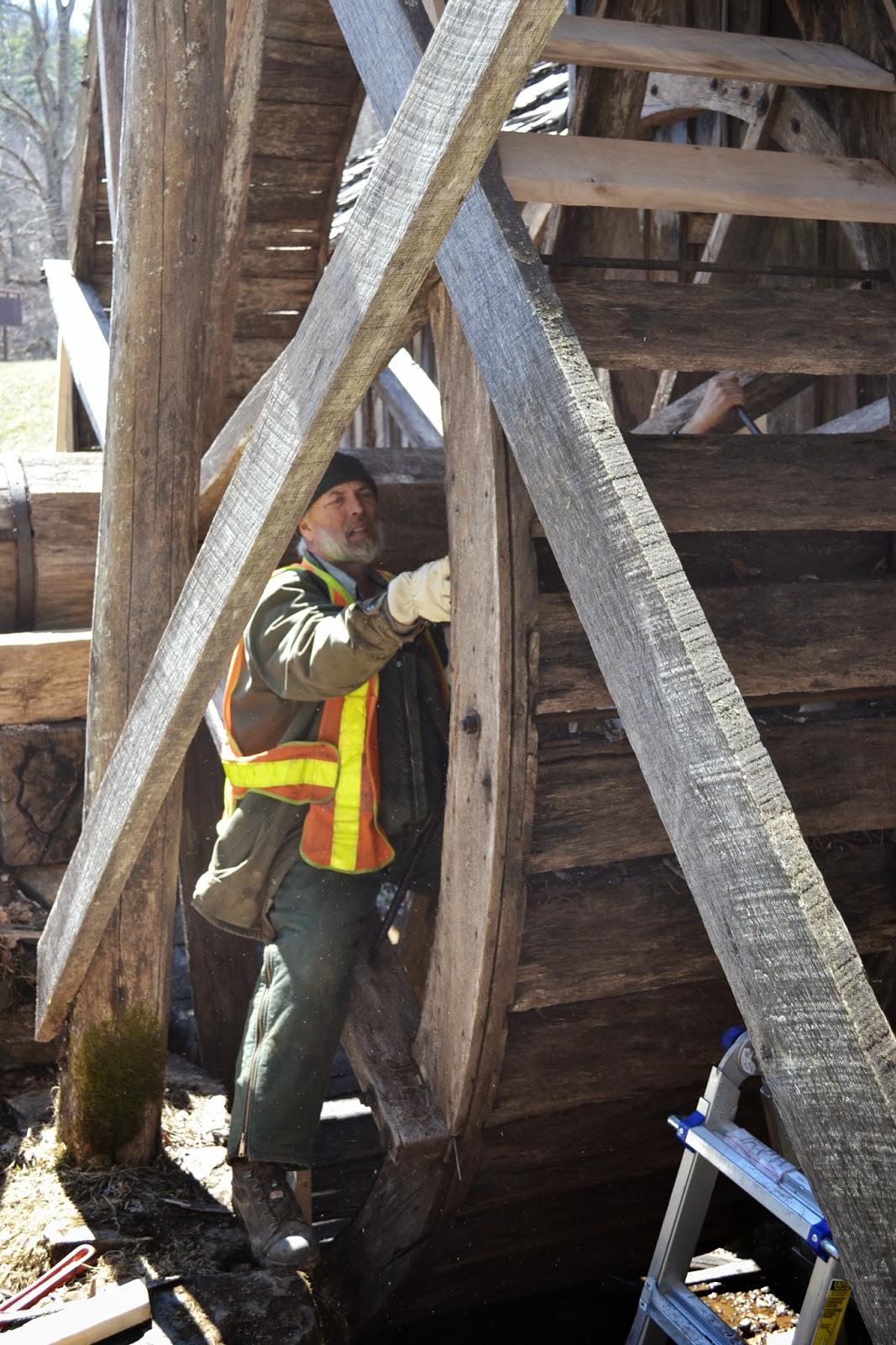 | ||
| David Cannaday, sitting in the wheel, removing old bucket boards and replacing with the new components |
Working in these awkward positions made the job tougher. There were long threaded rods to be removed, then worn out backing boards and bucket bottoms and always old, rusty nails. Some could be pulled out; others could only be sawn through with a big tough reciprocating tool called a Sawzall. I've heard backyard carpenters refer to these things a "Rambo" after the weapon carried by movie character John Rambo. If you've got to remove something, or just tear it up, it's just the ticket. But in this case, Parkway employees used the Sawzall like a surgeon wields a scalpel -- making short cuts, just enough to get through the next obstruction, clear out the old and make way for the new.
 |
| Jack Trivett works part of a new bucket into the L-shaped grooves on the insides of the waterwheel. |
 |
| Steve Marmie pulls a bucket component into the slot |
The next photo shows one segment of new water buckets, awaiting new backing boards, on one of the eight sections of the waterwheel. This can be tedious work -- trying to maintain a high standard of craftsmanship on a structure that has been remade a number of times, with an array of different fasteners that can present all kinds of problems.

The work proceeded section by section, removing threaded rods and replacing them when the new bucket pieces were in place.
 |
| Jack Trivett, left, and Steve Marmie work on a bucket |
Once all the new bucket components were in place, white oak backing boards were fastened to the inside of the waterwheel, completing the basic three-piece bucket. Yet to come are strips of thinner white oak that have been soaking in a nearby Mabry Mill creek to keep them pliable and bendable before they go around the rims.

This next photo shows the waterwheel with a complete new set of buckets -- though a number of pieces are yet to be added. But first, there's a big job left -- replacing badly deteriorated blocks holding up the axle. Read about it next time in Chapter 6 of Rocky Knob Blog's series on the renewal of Mabry Mill.

The final photo shows how Mabry Mill's rebuilt waterwheel looked with new buckets on the afternoon of April 1.

Wednesday, April 2, 2014
Revamping a Southern Appalachian icon, Chapter 4: The Tree
 |
| Photos by Jack Betts, Rocky Knob Writery LLC |
The National Park Service and its Blue Ridge Parkway staff faced a big problem when it came time to rebuild the waterwheel at Mabry Mill, one of the most popular stops on the Parkway and, some believe, one of the most photographed spots in America's park system: Finding a big source of big timber. Not only did the Parkway need a certain kind of rot-resistant, tough wood, but it needed it in big dimensions -- 15-inch wide planks and big square balks of lumber strong enough to hold up the heavy wheel during its endless poundings and stress when the mill is in operation.
White oak was the answer, but where would they find it? As it turned out, by the side of the road.
"I called four or five sawmills that I knew personally, and none of them could do it. They couldn't stop their production runs to do it," recalls Jack Trivett, a specialist at the Historic Preservation Shop near the Cone Manor outside Blowing Rock, N.C.
But Trivett remembered a huge 75-foot white oak that had fallen just off the Parkway in the E.B Jeffress Park, about 100 miles down the Parkway from Mabry Mill. It was an enormous tree, a blown-over giant still anchored to its root system but pitched down a steep 50-degree slope. It would be dangerous to get out, and Park Service officials were reluctant to try it out of safety concerns. But the tree held the kind of timber the Parkway needed to restore the waterwheel and other elements at Mabry Mill -- and it wouldn't put additional strain on the Parkway budget to harvest some of it. The tree, after all, was still in good shape, but if the Parkway didn't take any of it for the restoration, the tree eventually would deteriorate.
"I knew about this tree," Trivett said. "It was down a couple of years but still in good shape. The wood was still wet, and that was what we were after."
Getting sections of the trunk out would require a lot of power. The crew chained a big backhoe to a big BRP truck to provide the traction, and Parkway employees sawed out sections to drag back up to the road and load on a truck. The Parkway brought in its arborist, Plant Ecologist Chris Ulrey, for advice on dealing with how to retrieve the tree. Ulrey said he took at look at a cross-section to determine its age, and a surprise emerged. "This was a very slow-growing tree with tight growth rings," he said. He gauged a section of those rings and made a calculation: The tree was roughly 400 to 500 years old -- "Not less than 400, and possibly older than 500," he said. If the tree was more than 500 years old, it meant that this white oak could have been a seedling when Christopher Columbus first came to the New World. The tree had been growing all that time, and now was about to provide the big timber for Mabry Mill's waterwheel.
 |
| Steve Marmie points out the white oak rings |
Once they found the tree, the Parkway then had the task of cutting it up into usable lumber. But this was an easier solution. The Parkway had previously gotten help from Glenn Bolick's lumberyard just south of Blowing Rock in the Blackberry community. It's a traditional yard, with a big old mill powered by a big old GM Diesel, and using the chain-and-ratchet gizmos and big circular saw blades that loggers have used everywhere for more years than they can count. No computer-guided technology here, just the experience and judgment and sawmill savvy of Glenn Bolick. Bolick, by the way, is not only a logger but also a noted potter, storyteller and musician who, his daughter Janet said, plays the guitar "and piddles with the banjo and the fiddle."
 |
| Jack Trivett and Steve Marmie consult with Glenn Bolick about their cut list |
On a cool, foggy late February day, using the same backhoe that fetched the tree sections out of the Jeffress Park, Trivette picked up the first section and put it on the rails that move trunks to the carriage that will pull the timber through the saw. Steve Marmie used a cant hook to help position the tree.
 |
| Bolick and Marmie hold cant hooks, the contraptions that loggers used to move logs around |
 | |
| Trivett and Bolick discuss where to make the first cuts |
 | |
| Bolick sharpens his 52-inch saw blade |

After removing the outside lumber, cutting the usable planks began. Trivett helped pull the planks off the mill and stack them nearby.

Sometimes they were cutting 1-inch planks, sometimes 3-inch stock

And sometimes they cut the big blocks that would replace the worn-out blocks holding up the outside axle end of the waterwheel.


Next on Rocky Knob Blog: pulling off the bad wood and putting on the good, in Reconstructing a Southern Appalachian icon, Chapter 5: Not quite reinventing the Wheel
Saturday, March 29, 2014
Renewing a Southern Appalachian icon, Chapter 3: The wood
 |
| All photos by Jack Betts, Rocky Knob Writery LLC |
When you're rebuilding what may the most famous mill in the National Park Service system, you don't just run down to Lowe's or Home Depot to get some 1x12s and 6x6s and a box of galvanized nails. For one thing, the kinds of wood you need and the dimensions you need them in won't be found even in most specialty lumberyards, where custom cuts can be arranged at a price that would raise the remaining hair on the frazzled heads of accountants at government agencies such as the U.S. Department of the Interior or development officers at private, non-profit groups dedicated to taking up the slack in parks across the country. Fortunately for this project, the Blue Ridge Parkway Foundation (brpfoundation.org), which provides a broad array of services, programs, funding and other support for the Parkway, committed to raising $65,000 to pay for the restoration project. The job includes dredging the millpond, reconstructing the waterwheel and repairing the damaged and clogged log flumes that collect the water to turn the wheel.

And one of the things that is particularly hard to find is the expertise to do this sort of historic preservation work. True, there are amazing craftsmen and women across the country with phenomenal skills in the workshop and in the field. But how often do you need to restore a waterwheel with complicated cast iron parts attached to custom-cut wooden pieces, first designed more than a century ago, remade during World War II, and occasionally redone in the decades since then? The last time the waterwheel at Mabry Mill was rebuilt was nearly two decades ago -- 1995. Back then, the Historic Preservation Shop at Sandy Flats near the Cone Manor in Blowing Rock, N.C. had six people working there, including Larry Hampton, now retired from the Park Service, who did the dredging work a couple weeks ago at Mabry Millpond.

These days, due to budget cuts imposed by Washington, the staff of the Historic Preservation Shop is down to two: Steve Marmie and Jack Trivett. When they began planning how they would restore the waterwheel, they knew finding the right woods in the sizes they needed would be a big problem. At Mabry Mill, they knew they would need hemlock in certain dimensions to repair the log flumes that bring water to the wheel. But only one thing would do for the buckets and backing boards and face boards and other components of the wheel: "White oak -- that's all we use," Marmie said one cold winter morning earlier this year as he showed me around the shop. Other kinds of oak are tough, but none is as weather resistent and none is as close-grained, and as watertight, as white oak.

Nor as hard to find. Trivett called all the lumberyards he knew about in search of white oak 15 inches wide. None had exactly what he needed, but he found a supplier in Spartanburg, S.C. that could supply some of the oak for the buckets on the waterwheel -- basically two pieces in different dimensions, with differing angles of joints, that would be set into grooves on the basic structure of the existing waterwheel.
 |
| Jack Trivett, left, and Steve Marmie show hoe two bucket components will fit together |
Over the winter they fabricated the new bucket parts at the Sandy Flats shop, and sawed out new curved facing pieces. To get the width of those curves just right, they fashioned two different woodworking jigs to cut the inner and outer curves on bandsaws.
 |
| Jack Trivett demonstrates sawing out an inner curve on a waterwheel facing board |
They caught one break: the main axle, the spokes and the outer band of the wheel were in good shape. All were of white oak, and the Parkway workers would not have to replace those. But some of the heavy blocks holding up the wheel on the pond side of the mill were clearly deteriorating and would have to be replaced. Somehow Marmie and Trivett would have to find huge blocks of white oak, but that was another problem.

Next on Rocky Knob Blog: Chapter 4, The Tree
Subscribe to:
Posts (Atom)