Almost everyone I know is a better gardener than I am and they grow a whole lot more stuff than we do here at 3,186 feet of elevation. But this has been a wonderful year, starting with a long slow spring without a bad late freeze, enough rain often enough, and some unseen hand from a higher power constantly helping things along. There are tassels on the corn now, 'taters are lovely, onions seem to be holding their own, zukes and cukes and crooknecks still put out, the peppers come and they go, but mostly they come in batches, the rabbit-eye blueberries have come in strong and the 'maters, by golly, we're getting enough to start a produce stand. Here's
one 15-minute harvest, not counting the slightly nibbled 'maters I threw in the crick:
Let's see, those red things include cocktail tomatoes, Romas, Dolly Partons, German Johnsons and I think a Big Boy or two. Jane Kendall and I used to laugh about how we liked our 'mater sammiches: "Made at 8 and eat at noon." Now that we're knee-deep in this 'mater bounty, I think I'll fry a mess of 'em up in cornmeal and bacon grease for breakfast tomorrow. Reminds me of what Woody Durham used to say when the Tar Heels were on a roll: Go To War, Miss Agnes!
P.S.: I always wondered what that meant, and a few minutes after posting about 'maters, I looked it up on the world wide interweb. Turns out to be one of Chuck Thompson's on-air gems, some years before Woody. Here's what Wikipedia has to say:
Charles L. "Chuck" Thompson (June 10, 1921–March 6, 2005) was an American sportscaster best known for his broadcasts of Major League Baseball's Baltimore Orioles and the National Football League's Baltimore Colts. He was well-recognized for his resonant voice, crisply descriptive style of play-by-play, and signature on-air exclamations "Go to war, Miss Agnes!" and "Ain't the beer cold!".
So there you go. How 'bout them 'maters?
Monday, August 17, 2015
Saturday, August 8, 2015
Lost in the Fifties Tonight
About, oh, 50 years ago, when Wood Allen and Fred Birdsong
and Jimmy "Squirrel" Garrison and I were figuring on a big show biz
career displacing the Kingston Trio and other giants of the 1950s and early 1960s entertainment
business, we didn't know much about how to do it. I had a an old
sawed-off Roy Rogers (or was it a Sears Roebuck?) 6-string guitar that Wood gave me, and that I had tried to turn into a
4-string tenor guitar like Nick Reynolds played. When we needed some
serious gravitas and percussive thump, I used to borrow an old Alcoa aluminum guitar from the
next-door neighbor of a friend on West Market Street in Greensboro.
We didn't
know squat, but we didn't know we didn't know squat, so we were deliriously
happy in our ignorance, bound as we were for the top, like a rocket ship about
to be fire off of Cape Canaveral.We were saved from a degrading life of too much money, too much fame and too much substance abuse when we didn't go straight to the top, or the middle, or anywhere close to it. But we had a lot of fun, over the years playing in sometimes odd, out-of-the-way places. That live on-air performance at a little AM radio station in Danville was a thrill. Helen, GA., was fun. And we set the place on fire a couple times at weddings of daughters in Iredell and Buncombe counties.
By then I had bought an old 1946 Kay doghouse bass with a partly broken neck, dings all over the body and some ancient strings. Scrangs, Fred called 'em. But it sure did sound good when we got together. We lost Fred one night in Alabama when he was returning from a prison ministry session where he counseled inmates, and was killed by a drunken driver. The bass burned up in a 2010 house fire. Squirrel died after a noble five-year fight against three or four kinds of cancer.
Wood and I still play, mostly a lot of folk music from the 1950s, but some newer stuff as well. A few years ago I discovered a nice 1959 Kay bass up at Jerry Fretwell's bass shop in downtown Staunton, VA, and bought it up with a nice soft set of Silver Slap scrangs. Easy on the hands, and sounds good. Enjoyed playing it, and was taking up the tenor guitar again with a Martin knock-off made in China. Cheap, and a thing of beauty, though what I really wanted was a Martin. Just too costly.
Then just the other week, after a household emergency forced me to cancel a long-planned trip to hang around the Kingston Trio Fantasy Camp in Scottsdale, AZ, a fellow there let me know someone was selling a 1957 Martin tenor guitar, with a hard case, for a very good price. Wood was flying out there to perform, and he and several friends took a look and bought it on the spot, found a shipping box and dropped it off at UPS. It arrived here at the Rocky Knob Tractor & Yacht Club Thursday afternoon, where it took up residence in the conservatory right next to my '59 doghouse bass. When I took it out of the box, the Martin was still in tune -- though an incoming storm front here soon took care of that. But it plays as sweet today as it must have for its other owners over time.
Here's a look at the Kay Martin duo:
| 1959 Kay bass, left; 1957 Martin 0-18t tenor guitar, right. |
I am mindful that since becoming an age-eligible geezer, there's some danger in acting as though everything was wonderful in the 1950s, when it wasn't at all. But some things were right. We passed a '55 Chevy on U.S. 58 the other day, and I got the sort of twinge I usually get when I think about that old '56 Chevy Bel Air two-toned sedan with the small-block V8 that I sold for $65 right before going off to the Army in 1969. Some days I wish I had that old boy back. Not that I could put it in the conservatory, of course, but the back seat was big enough to carry a doghouse bass AND a tenor guitar, at least with the seat yanked out. If you see a '56 in good shape for a good price, do me a favor and don't give me a call. I got more old stuff than I need, including some really old knees. But thanks just the same.
ck
Wednesday, July 15, 2015
Of peaches and hardware and pitchers of something cold
Nothing quite like a birthday nearing the end of my seventh decade to remind me of how quickly things change -- and how some of the landmark institutions I once took for granted have already passed from reality into the realm of memory. I thought about this last week when I was in Slaughter's market in Floyd, and saw the first really good-looking peaches of the year. More are likely to be in this week, the produce manager told me, and we made a mental note to drop by and buy a box when they arrive.
We're particular about peaches, and when we lived in North Carolina, we always watched out for the coming of peaches from the Auman family orchard down in the Sandhills. I had worked with Bob Auman at the Greensboro Daily News shortly after the crust of the earth cooled many years ago, and covered his dad, Rep. T. Clyde Auman, in his latter years in the General Assembly. But mostly I recall the occasional interview when National Public Radio's Bob Edwards would call Watts Auman, who ran the orchard during those years, and talked about the incoming peach crop in North Carolina and how that late freeze or the prolonged drought or the fine spring weather might affect the crop.
Alas, the Auman family decided to get out of the peach business last year, and this is the first year that many customers heard of it. I read in one news story that customers were driving up to the orchard only to find trees removed and packing houses empty. For many families it would be the first summer season in their lives without Auman peaches on the table.
Thus is goes. Cellar Anton's, a favorite Greensboro haunt of my early dating days in the 1960s, and an eatery that we teenagers thought both sophisticated and cosmopolitan, has closed. I gave a girl a ring there one evening in 1965 over a dish of moussaka and a pitcher of something cold, and three years later we married.
Briggs Hardware in Raleigh -- virtually a daily stop for me when it was downtown for more than a century on Fayetteville Street, and later an easily-accessed morning stop on my way to work at its North Raleigh location, has closed its doors. When I first started going in to the squeaky-floored store just down from the Capital in the 1970s, old Mr. Jimmy Briggs used to ring me up as he crooned a little ditty he had sung for Greensboro Daily News correspondents for 40-some years, he claimed: "The Daily News/Is mostly used/For wrapping fish/And worn-out shoes." You don't get that at Lowes or Home Depot, you know.
These were wonderful places and I'm sorry to see them go, but there's also a world of new places to haunt and things to find and craft beers to sample -- more than I'll be able to get to, I expect, but I'm going to give it a try. We're off today to hunt for a good bike shop, and a new restaurant down in the western Piedmont. We'll toast the Aumans and Antons and Briggses of the world with a new IPA somewhere, and look forward to their successors. Cheers!
We're particular about peaches, and when we lived in North Carolina, we always watched out for the coming of peaches from the Auman family orchard down in the Sandhills. I had worked with Bob Auman at the Greensboro Daily News shortly after the crust of the earth cooled many years ago, and covered his dad, Rep. T. Clyde Auman, in his latter years in the General Assembly. But mostly I recall the occasional interview when National Public Radio's Bob Edwards would call Watts Auman, who ran the orchard during those years, and talked about the incoming peach crop in North Carolina and how that late freeze or the prolonged drought or the fine spring weather might affect the crop.
Alas, the Auman family decided to get out of the peach business last year, and this is the first year that many customers heard of it. I read in one news story that customers were driving up to the orchard only to find trees removed and packing houses empty. For many families it would be the first summer season in their lives without Auman peaches on the table.
Thus is goes. Cellar Anton's, a favorite Greensboro haunt of my early dating days in the 1960s, and an eatery that we teenagers thought both sophisticated and cosmopolitan, has closed. I gave a girl a ring there one evening in 1965 over a dish of moussaka and a pitcher of something cold, and three years later we married.
Briggs Hardware in Raleigh -- virtually a daily stop for me when it was downtown for more than a century on Fayetteville Street, and later an easily-accessed morning stop on my way to work at its North Raleigh location, has closed its doors. When I first started going in to the squeaky-floored store just down from the Capital in the 1970s, old Mr. Jimmy Briggs used to ring me up as he crooned a little ditty he had sung for Greensboro Daily News correspondents for 40-some years, he claimed: "The Daily News/Is mostly used/For wrapping fish/And worn-out shoes." You don't get that at Lowes or Home Depot, you know.
These were wonderful places and I'm sorry to see them go, but there's also a world of new places to haunt and things to find and craft beers to sample -- more than I'll be able to get to, I expect, but I'm going to give it a try. We're off today to hunt for a good bike shop, and a new restaurant down in the western Piedmont. We'll toast the Aumans and Antons and Briggses of the world with a new IPA somewhere, and look forward to their successors. Cheers!
Thursday, June 18, 2015
One harvest ends, another about to start
About 85 or 90 pounds ago, maybe more, this green stuff started almost jumping out of the ground where the Connors or the Woods once had their dairy barn. It's the plot where the late Hal Strickland and his wife Frannie first planted asparagus about, I think 40 years ago. Maybe a little more. They bought the farm for less than $200 an acre, and probably within a few years were growing prize-winning asparagus, at least in our minds. Frannie hauled a bunch of it to Greensboro for years while it was coming up, and gave away, I'd guess, several thousand pounds of it over the years. I know we carried a couple hundred pounds of it during its 8-10 week growing season during our working years.
But at a certain point you have to let the asparagus patch go. After Hal died, we made the asparagus patch smaller and easier to maintain. Or so we thought. Still takes a lot of work to keep it weeded (we're behind) and whack back the encroaching foliage from the field (we're a bit ahead on that) and you still have to do everything else that goes with minding an asparagus patch, a sizeable blueberry patch and the vegetable garden down by the creek. I don't see how the Stricklands managed to keep it all going in their advancing years, but one thing was obvious: they spent a lot of time and effort on it. Just plain hard backbreaking work.
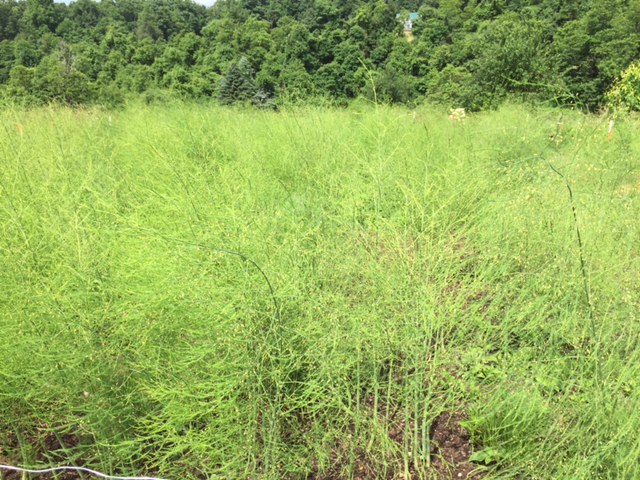
Last week, blessedly, we cut the last 14.8 ounces of asparagus and shared it with neighbors who were frying up some fresh-caught bream and bass from the pond. Now it's in full fern, as you can see:
Over the winter, we dug up some blueberry bushes Hal had planted on an Eastern-facing slope years ago. They bore some berries, but not a lot, and Hal asked me to transplant them when I could. But the time I got around to it, they were so large I needed an industrial-sized backhoe to dig 'em up. So we pruned four of them to manageable size, dug up most of that, whacked them into smaller pieces and potted some for replanting (two will go to our niece in honor of her baby daughter, Fiona Grace) next year and put four or five into the big blueberry patch on a Western-facing slope. To our utter astonishment, they all are still alive and putting out foliage, and three of them have a few berries on them.
A couple days ago I noticed that one of the older, early bushes was blushing -- from green to pink and ruddy and running on toward that purplish sweetness that tells you in a couple more days there will be magic on the table again. Here's a picture of the early berries, not far from being ready. Well, okay, maybe a little longer than that. I'm an optimist when it comes to berries, and I'm looking forward to dressing up my morning Cheerios this summer, and my winter oatmeal come December, with a big pile of 'em.
But at a certain point you have to let the asparagus patch go. After Hal died, we made the asparagus patch smaller and easier to maintain. Or so we thought. Still takes a lot of work to keep it weeded (we're behind) and whack back the encroaching foliage from the field (we're a bit ahead on that) and you still have to do everything else that goes with minding an asparagus patch, a sizeable blueberry patch and the vegetable garden down by the creek. I don't see how the Stricklands managed to keep it all going in their advancing years, but one thing was obvious: they spent a lot of time and effort on it. Just plain hard backbreaking work.
Last week, blessedly, we cut the last 14.8 ounces of asparagus and shared it with neighbors who were frying up some fresh-caught bream and bass from the pond. Now it's in full fern, as you can see:
Over the winter, we dug up some blueberry bushes Hal had planted on an Eastern-facing slope years ago. They bore some berries, but not a lot, and Hal asked me to transplant them when I could. But the time I got around to it, they were so large I needed an industrial-sized backhoe to dig 'em up. So we pruned four of them to manageable size, dug up most of that, whacked them into smaller pieces and potted some for replanting (two will go to our niece in honor of her baby daughter, Fiona Grace) next year and put four or five into the big blueberry patch on a Western-facing slope. To our utter astonishment, they all are still alive and putting out foliage, and three of them have a few berries on them.
A couple days ago I noticed that one of the older, early bushes was blushing -- from green to pink and ruddy and running on toward that purplish sweetness that tells you in a couple more days there will be magic on the table again. Here's a picture of the early berries, not far from being ready. Well, okay, maybe a little longer than that. I'm an optimist when it comes to berries, and I'm looking forward to dressing up my morning Cheerios this summer, and my winter oatmeal come December, with a big pile of 'em.
Monday, June 1, 2015
Sittin' on the Dock of the Bay
Kenneth Grahame was on to something when he wrote these words in 1908: "There is nothing - absolutely nothing - half so much worth doing as simply messing about in boats." Grahame was retired then, from the Bank of England, and writing down the stories he told his son about the River Thames. Some of them wound up in "The Wind in the Willows," and though it's a child's book, it still reflects the fascination some of us have with the watery side of the world.
I do most of my messing about in boats from a rocking chair these days, just like the ones that adorn the porches and decks and docks of hundreds of little places along the Intracoastal Waterway and the little bayside and creekside towns that dot the East Coast's tangle of rivers and sounds and ports and backwaters.
They most recently included a week with two other couples on a Deltaville porch deck looking over Broad
Creek in Virginia's Middlesex County. Morning coffee on the porch turned into afternoon drinks and daylong reading, all the time keeping an eye on the high-dollar sportsfishermen and the bright white workboats that rumbled and grumbled their way down the creek and out onto the wide Rappahannock, just a few miles above its junction with the Chesapeake Bay. You can steam or sail anywhere in the aquatic world from Deltaville, of course, but we looked for the crabbers and the sloops and cutters and kayakers and boat-scopers who noodled and puttered back and forth every day on that quiet stretch of water.
Nearly six decades after Grahame wrote about boats, Otis Redding and Steve Cropper captured the serenity of watching the water in "Sitting on the dock of the bay:"
Sittin' in the mornin' sun
I'll be sittin' when the evenin' come
Watching the ships roll in
And then I watch 'em roll away again, yeah
I'm sittin' on the dock of the bay
Watchin' the tide roll away,
I'm just sittin' on the dock of the bay
Wastin' time.
Well, not wasted in my book, anyway. The six of us plowed through I don't know now many books -- a dozen at least, while sitting on that porch, when we weren't off testing restaurants for crabcakes or oyster po'boy sandwiches or the next round of craft beers or small-batch bourbons. And somehow we found time to mess about a couple of days in a fine, handsome Cape Dory 33 sloop our friends keep at a nearby marina, just a five-minute walk from our upstairs perch.
The wind was up in the high teens on one sail, which involved more hanging on and bracing for gusts into the 20's while thrashing up towards the iconic 1957 Robert Norris bridge over to Kilmarnock. A sail later in the week was calmer, jetting out into the Chesapeake on one long starboard tack and returning to the Broad Creek daymarkers on one long port tack on a rising wind.
In our sailing and motoring days we have seen the Intracoastal up close from Vero Beach to Oriental, and shorter stretches of the more northerly sections. We have also spent a good deal of productive time sitting on docks in river towns like Beaufort and Beaufort -- distinctly different places that provide spectacular views of the riverine and inlet worlds -- and quiet places like Pecan Grove Marina just off Shop Gut near Oriental, where we recovered from a white squall on the lower Neuse, and the old River Forest Marina just off the waterway in Belhaven. So we're adding Deltaville to our list of grand places to sit and watch 'em roll in, and watch 'em roll away again. Wasting time, you know, is easy, but knowing where to do it -- that's the key.
I do most of my messing about in boats from a rocking chair these days, just like the ones that adorn the porches and decks and docks of hundreds of little places along the Intracoastal Waterway and the little bayside and creekside towns that dot the East Coast's tangle of rivers and sounds and ports and backwaters.
![]() |
| The view from the porch on Broad Creek, Deltaville VA |
They most recently included a week with two other couples on a Deltaville porch deck looking over Broad
Creek in Virginia's Middlesex County. Morning coffee on the porch turned into afternoon drinks and daylong reading, all the time keeping an eye on the high-dollar sportsfishermen and the bright white workboats that rumbled and grumbled their way down the creek and out onto the wide Rappahannock, just a few miles above its junction with the Chesapeake Bay. You can steam or sail anywhere in the aquatic world from Deltaville, of course, but we looked for the crabbers and the sloops and cutters and kayakers and boat-scopers who noodled and puttered back and forth every day on that quiet stretch of water.
Nearly six decades after Grahame wrote about boats, Otis Redding and Steve Cropper captured the serenity of watching the water in "Sitting on the dock of the bay:"
Sittin' in the mornin' sun
I'll be sittin' when the evenin' come
Watching the ships roll in
And then I watch 'em roll away again, yeah
I'm sittin' on the dock of the bay
Watchin' the tide roll away,
I'm just sittin' on the dock of the bay
Wastin' time.
Well, not wasted in my book, anyway. The six of us plowed through I don't know now many books -- a dozen at least, while sitting on that porch, when we weren't off testing restaurants for crabcakes or oyster po'boy sandwiches or the next round of craft beers or small-batch bourbons. And somehow we found time to mess about a couple of days in a fine, handsome Cape Dory 33 sloop our friends keep at a nearby marina, just a five-minute walk from our upstairs perch.
The wind was up in the high teens on one sail, which involved more hanging on and bracing for gusts into the 20's while thrashing up towards the iconic 1957 Robert Norris bridge over to Kilmarnock. A sail later in the week was calmer, jetting out into the Chesapeake on one long starboard tack and returning to the Broad Creek daymarkers on one long port tack on a rising wind.
In our sailing and motoring days we have seen the Intracoastal up close from Vero Beach to Oriental, and shorter stretches of the more northerly sections. We have also spent a good deal of productive time sitting on docks in river towns like Beaufort and Beaufort -- distinctly different places that provide spectacular views of the riverine and inlet worlds -- and quiet places like Pecan Grove Marina just off Shop Gut near Oriental, where we recovered from a white squall on the lower Neuse, and the old River Forest Marina just off the waterway in Belhaven. So we're adding Deltaville to our list of grand places to sit and watch 'em roll in, and watch 'em roll away again. Wasting time, you know, is easy, but knowing where to do it -- that's the key.
Wednesday, May 6, 2015
And then the wheel came off
Back in 1977, when I was still young, my father-in-law acquired a beast of a machine -- a big 7-horse Troy Bilt rear-tine tiller that was the envy of this part of Belcher Mountain Road. Well, okay, there weren't any close neighbors then, and few neighbors now, but it was a marvel. It would tear up patches of ground on this old farm pretty fast and turn them into nicely-tilled gardens for more than three decades of garden bounty. There's not a long growing season up here at about 3,000 feet, but it's a mighty productive short season when there's just enough rain and not too much wind.
Thing is, a 38-year-old tiller can be a lot of work just to get ready to have it do all the work. I sent this old boy to the shop last fall for a good worming-out, new plug and new fuel line. Even when it gets good care, it's a chore just to crank, as I relearn each spring. The pull-cord is a good four feet long and requires throwing some body weight with it. When 10 pulls don't do the trick, it's back to the basics. Fuel cock opened? Choke on "on"? Fuel valve opened up just right? Tiller controls on neutral? Sigh. Sometimes, when nothing else works right, you just have to pull the plug, squirt in some WD 40 or some such, and crank it into life, hoping the thing won't blow itself to pieces. Then it's a matter of wrestling the thing down to the garden, through the gate and into position to till a straight line for the potatoes. And this point, I was pretty worn out pulling on the cord, but happy to finally be ready to till.
I was five feet away when the wheel came off. I hope no one could hear me over the roar of the old engine, because the air momentarily turned blue -- what the great editor and professor Jim Shumaker would have described as a flow of molten profanity. Somehow the beast had dropped a bolt on the port side of the tiller and the wheel had simply done what it was bound to do: spun itself off the axle. This resulted in half a morning looking in the grass for the missing bolt (futilely); running back to the barn to find a replacement (four candidates, with nuts, just to make sure I got the right size); back down to the garden to see which of them would fit (one of them), and then another 20 minutes while I figured out how to tighten down a two-inch bolt in a space where there is insufficient space to insert two fingers, let alone one socket wrench and one crescent wrench (more molten incantations.)
At last I got it all together and fired back up and heaved into position to begin tilling. Cranked up the fuel feed, threw it into forward and slow, and held on as it bucked and jumped and bounced side to side whenever it hit a rock of any size. The first pass approximated what artists call an S-curve, but I figured out how to straighten it out -- by throwing myself on top of the tiller, hoping that 180 pounds of old man would help stabilize a beast that still plenty of go and not much whoa.
When I finished, it looked pretty good, but I felt like I had just gone 10 rounds with Strangler Lewis. I retired to the house, found a shady spot on the deck and read the latest Rick Bragg book for a couple of hours in quiet bliss. Those 'taters could wait for another day.
Thing is, a 38-year-old tiller can be a lot of work just to get ready to have it do all the work. I sent this old boy to the shop last fall for a good worming-out, new plug and new fuel line. Even when it gets good care, it's a chore just to crank, as I relearn each spring. The pull-cord is a good four feet long and requires throwing some body weight with it. When 10 pulls don't do the trick, it's back to the basics. Fuel cock opened? Choke on "on"? Fuel valve opened up just right? Tiller controls on neutral? Sigh. Sometimes, when nothing else works right, you just have to pull the plug, squirt in some WD 40 or some such, and crank it into life, hoping the thing won't blow itself to pieces. Then it's a matter of wrestling the thing down to the garden, through the gate and into position to till a straight line for the potatoes. And this point, I was pretty worn out pulling on the cord, but happy to finally be ready to till.
I was five feet away when the wheel came off. I hope no one could hear me over the roar of the old engine, because the air momentarily turned blue -- what the great editor and professor Jim Shumaker would have described as a flow of molten profanity. Somehow the beast had dropped a bolt on the port side of the tiller and the wheel had simply done what it was bound to do: spun itself off the axle. This resulted in half a morning looking in the grass for the missing bolt (futilely); running back to the barn to find a replacement (four candidates, with nuts, just to make sure I got the right size); back down to the garden to see which of them would fit (one of them), and then another 20 minutes while I figured out how to tighten down a two-inch bolt in a space where there is insufficient space to insert two fingers, let alone one socket wrench and one crescent wrench (more molten incantations.)
At last I got it all together and fired back up and heaved into position to begin tilling. Cranked up the fuel feed, threw it into forward and slow, and held on as it bucked and jumped and bounced side to side whenever it hit a rock of any size. The first pass approximated what artists call an S-curve, but I figured out how to straighten it out -- by throwing myself on top of the tiller, hoping that 180 pounds of old man would help stabilize a beast that still plenty of go and not much whoa.
When I finished, it looked pretty good, but I felt like I had just gone 10 rounds with Strangler Lewis. I retired to the house, found a shady spot on the deck and read the latest Rick Bragg book for a couple of hours in quiet bliss. Those 'taters could wait for another day.
Thursday, April 23, 2015
Prize-winning colleagues, every one
Someone said a long time ago it's not enough to be good; you've got to be lucky, too. Dunno about the good part, but I do know that I've been a lucky guy for just about every one of these going-on 69 years. Had good parents, good teachers, good editors, good friends and good times. Had superb bosses along the way -- Irwin Smallwood and John Alexander at the Greensboro Daily News, Ran Coble at the NC Center for Public Policy Research in Raleigh and Ed Williams and Rich Oppel at the Charlotte Observer.
But today I'm writing about the people I worked with and who have been recognized by their collegues as THE best in the business. I'm talking about Maria Henson, who won the Pulitzer Prize for her editorials about battered women when she worked for the Lexington Herald-Leader in Kentrucky. She later joined the editorial staff at the Observer and worked for several years with me in the Observer's Raleigh Bureau. With her energy and drive and insistence on good writing and and her impatience with ineffective government, Maria showed why she won journalism's top prize. She's now Associate Vice President and Senior Editor at Wake Forest University.
And I'm talking about Kevin Siers, the Minnesotan who came south to draw pictures for the Observer's editorial pages a couple of decades ago and won the Pulitzer Prize in 2014 for "thought provoking cartoons drawn with a sharp wit and bold artistic style." Kevin's work was at times hilarious and and times painfully poignant but always with a sharp point. He was also a most collegial co-worker. I never spent more than a week or two in Charlotte at any one time, but always enjoyed wandering into his office to see what he was working on, and to get him to tell me how he was doing. Almost every time it was, "Not too bad." Yep. Pulitzer Prize. Not too bad.
And I'm talking about Washington Post reporter Carol Leonnig, who this week won the Pulitzer Prize for her reporting about wrongdoing and mismanagement in the Secret Service. She was part of a team that won last year's Pulitzer Prize for its reporting on national security issues, and won various other prizes for her investigative reporting, including stories about Virginia Gov. Bob McDonnell and his wife that eventually led to their convictions in court. Carol worked in the office next to me in the Observer's Raleigh Bureau, and watching her investigate wrongdoing in state government was like being in a classroom with an excellent teacher. Haven't known many people who could so quickly develop such good sources that produced so many useful stories that fulfilled the newspaper's key job of watching and reporting the truth.
It surprises me not one whit that Maria, Kevin and Carol won the Pulitzer. It does surprise me that many of my other colleagues at the Observer and in Greensboro have not also won the big prize for their labors in uncovering stories that huge institutions such as government and business did not want in print. Their work was excellent and unrelenting and deserving of high honors, and maybe someday they will get them.
I won more than my fair share of prizes and honors in my four decades of journalism, but the closest I came to the big prize was probably the delightful meal served up by my then-Greensboro colleague, Windy March, now in Florida. It was a chicken dish -- appropriately called "The Pullet Surprise." It was a prize-winner, too.
But today I'm writing about the people I worked with and who have been recognized by their collegues as THE best in the business. I'm talking about Maria Henson, who won the Pulitzer Prize for her editorials about battered women when she worked for the Lexington Herald-Leader in Kentrucky. She later joined the editorial staff at the Observer and worked for several years with me in the Observer's Raleigh Bureau. With her energy and drive and insistence on good writing and and her impatience with ineffective government, Maria showed why she won journalism's top prize. She's now Associate Vice President and Senior Editor at Wake Forest University.
And I'm talking about Kevin Siers, the Minnesotan who came south to draw pictures for the Observer's editorial pages a couple of decades ago and won the Pulitzer Prize in 2014 for "thought provoking cartoons drawn with a sharp wit and bold artistic style." Kevin's work was at times hilarious and and times painfully poignant but always with a sharp point. He was also a most collegial co-worker. I never spent more than a week or two in Charlotte at any one time, but always enjoyed wandering into his office to see what he was working on, and to get him to tell me how he was doing. Almost every time it was, "Not too bad." Yep. Pulitzer Prize. Not too bad.
And I'm talking about Washington Post reporter Carol Leonnig, who this week won the Pulitzer Prize for her reporting about wrongdoing and mismanagement in the Secret Service. She was part of a team that won last year's Pulitzer Prize for its reporting on national security issues, and won various other prizes for her investigative reporting, including stories about Virginia Gov. Bob McDonnell and his wife that eventually led to their convictions in court. Carol worked in the office next to me in the Observer's Raleigh Bureau, and watching her investigate wrongdoing in state government was like being in a classroom with an excellent teacher. Haven't known many people who could so quickly develop such good sources that produced so many useful stories that fulfilled the newspaper's key job of watching and reporting the truth.
It surprises me not one whit that Maria, Kevin and Carol won the Pulitzer. It does surprise me that many of my other colleagues at the Observer and in Greensboro have not also won the big prize for their labors in uncovering stories that huge institutions such as government and business did not want in print. Their work was excellent and unrelenting and deserving of high honors, and maybe someday they will get them.
I won more than my fair share of prizes and honors in my four decades of journalism, but the closest I came to the big prize was probably the delightful meal served up by my then-Greensboro colleague, Windy March, now in Florida. It was a chicken dish -- appropriately called "The Pullet Surprise." It was a prize-winner, too.
Subscribe to:
Posts (Atom)