It may have been the Knob Creek with honey and lemon that got me through one of the worst winter colds I've had in years. Or maybe it was the prospect of a family wedding on the island of Maui in Hawaii -- and the wintertime weather there. I've not spent any time there previously and likely won't be going back anytime soon, but I can tell you it was every bit the paradise written about in the travel guides. Back home in the Blue Ridge, it was minus 2 degrees F one night, and a heavy ice visitation came at least once. On the island of Maui, it was in the high 70s and low 80s and we were wearing shorts, T shirts and flip-flops and enjoying warm breezes, cool drinks and sunny beaches. I know, it isn't fair.
We were in Hawaii to celebrate the wedding of our grandfriend Riley Hart and Koniela Lurie. Riley has been a part of our lives for most of her life. When she was little she sometimes stayed with us in Raleigh, went sailing with us on our old cutter a few times and found her way into our hearts. Some years she comes on the family beach trip to Figure Eight, and visits us in the mountains. We're not kin in the traditional way, but she is family to us, as is her mom Joy and an extended circle of sisters, brothers, cousins, nephews and friends of each of them.
Our son John spent a lot of time with Riley as she was growing up and they are as tight as any father and daughter I know. John and our daughter Mary joined us for the wedding and for travel around the rest of the island. We also saw our nephew, Ian Strickland, who lives on Maui and who has known Riley for years as well. And John's friend Jana joined us a few days later.
Riley and Koniela were were married on a lovely Saturday evening, on a bluff high above the beach, on a community farm near Hana, in an unusual ceremony that included chimes, a flute, two friendly dogs, a gathering of family and close friends from as near as the next bungalow and as far away as Winston-Salem and Australia, and a good bit of quiet reflection. It was followed by hours of feasting in the community cafe with roasted wild beef and roasted pig, and guitar, banjo and other string music well into the night.
The day before the wedding we had found out how gorgeous those islands can be. We flew into Kahului, rented a car, stocked up at the Costco and the Whole Foods (where we ran into Joy, her husband Carl and Joy's sister Sterling, and set out on one of the most gorgeous rides we've ever seen. Listen, we live near the 469-mile Blue Ridge Parkway. We've driven the magnificent roads of Western North Carolina, through Arches National Park out West, and on the backroads above Bryce Canyon. But never have we seen anything remotely like The Road to Hana.
If you haven't experienced it, imagine a 50-mile road with 617 curves, 56 mostly one-lane bridges, dozens of waterfalls and places you simply have to stop and gape at the scenery around every curve. The rich, heady sight of tropical flowers, the vistas of the ocean and the black-sand beaches and the red-sand beaches, and the impossibly narrow curves where car drivers must slow nearly to a stop and inhale while they squeeze by the vehicle coming the other way make it an unforgettable trip. Just 50 miles to Hana, but it can take you all dadgum day to get there if you spend any time atall stopping to investigate the Rainbow Trees or the stunning falls of water, the dramatic and sometimes scary roadway built in the 1930s, or the remnants of the old sugar cane rail lines. It reminded me of those lines from Freeborn Man:
"I know every inch of highway, every foot of backroad, every mile of railroad track."
Well, I never exactly saw evidence of the old sugar cane train tracks, except in my mind, but plenty of the backroad parts. Fortunately, John was driving us, so for me it was rubbernecker's delight. All Martha and I had to do was hold on for 617 curves. It took more energy than you'd think, even with an expert driver.
I thought it would be hard to return to the mountains after those warm days on Maui and a few more on Oahu, but when we got home it was pushing 55 degrees in the mountains -- and the sun shone through Thursday. Caught up on the last of the Fall chores -- guttering the shop porch roof, putting up snow guard bars, taking down a couple of elderly locusts near the patio, reopening the trail down to the pond dam, mowing the dam top and starting the tricky task of pruning the blueberries on a west-facing slope. These chores never end on an old farm, but I was halfway through the week's work before I even remembered that hacking and wheezing of just a few weeks back. Remarkable how much good a warm sunny place can do you when a winter cold arrives. Today, the cold weather moves back in with a forecast of snow, freezing rain and sleet. I'll put away the aloha shirts and put a coda on a fine trip with a word Hawaiians use: Mahalo. Or as we say, Thank you.
Wednesday, January 21, 2015


Tuesday, December 30, 2014
Wheeze, honk and hack
The lump in the back of my throat Sunday night wasn't for my inept Tar Heels, who had gotten blown away by Rutgers a couple days earlier, or the Washington Redskins, which had gotten blown away by Dallas in a forgettable end to a forgettable season that represented an absolutely miserable experience for fans of these old teams this fall. Well, OK, beating Duke was nice, but East Carolina and N.C. State plumb wore us out and dumped us in the waste bin. Oh, me.
Nope, it was not a lump of sorrow. It was a lump of aggravated, annoyed, irritated, raw as hot gravelly gullet, and I knew what it meant. It was time for my biennial bout with the evils of the season -- what few medical specialists call the coldus hideosis horribilis, Latin for "You ain't gonna be fit to live with for some time, Bubba." That's a very rough translation, but it is what it is fixing to be: just godawful.
Back in my smoking days I used to get head colds with hacking coughs, explosive sneezes and an ample flow of nasty nasal emissions a couple times a year. When I finally quit after a couple of decades of abusing cigarettes, pipe tobacco, starlight mints and chewing gum, the rate of what we called Chapel Hill Chest Rattlers diminished considerably. Sometimes I'd go three years without one, but more usually every other year.
This one is a beast. Probably qualifies as a Belcher Mountain Wheezer. I'm surrounded by patent medicines, boxes of Kleenex (expect the stock to shoot up rapidly next week; I'm buying it by the freight car load), packs of exotic teas, vials of supplements in caplets and capsules and a little blue bottle with an eyedropper for dispensing some sort of potion said to ease pain, restore health and make childbirth a pleasure, a pitcher of Patrick County well water and, somewhere around here, a dwindling bottle of Knob Creek. It rained yesterday, then froze, then snowed and the thermometer is hanging around 29 while the wedge fog has us boxed in. Like the Bob Dylan song, You ain't goin' nowhere.
I have a stack of books -- a Bernard Cornwell, a Pat Conroy, a Michael Connely and a Burke Davis -- to keep me company, a stack of split oak on the deck that feeds the old wood stove and keeps it ticking, and a stack of blues CDs that I haven't listened to in years. They ought to be good for the soul in this winter of physical misery.
Don't think for a moment this is all bad. I've cleaned out five years of deleted e-mails, restored a Christmas card list lost in in a 2011 retirement move and decluttered a hard drive that had way too many widgets and tuits and thingamajigs that have been slowing the contraption down for a couple years. Found a couple of short story starts that still might lead somewhere, an outline for a book about growing up in the South and a first-whack at a song about the Blue Ridge. There's work to do here, son, and the sooner you get better, the sooner you can get going again! Now where's that Knob Creek....
Nope, it was not a lump of sorrow. It was a lump of aggravated, annoyed, irritated, raw as hot gravelly gullet, and I knew what it meant. It was time for my biennial bout with the evils of the season -- what few medical specialists call the coldus hideosis horribilis, Latin for "You ain't gonna be fit to live with for some time, Bubba." That's a very rough translation, but it is what it is fixing to be: just godawful.
Back in my smoking days I used to get head colds with hacking coughs, explosive sneezes and an ample flow of nasty nasal emissions a couple times a year. When I finally quit after a couple of decades of abusing cigarettes, pipe tobacco, starlight mints and chewing gum, the rate of what we called Chapel Hill Chest Rattlers diminished considerably. Sometimes I'd go three years without one, but more usually every other year.
This one is a beast. Probably qualifies as a Belcher Mountain Wheezer. I'm surrounded by patent medicines, boxes of Kleenex (expect the stock to shoot up rapidly next week; I'm buying it by the freight car load), packs of exotic teas, vials of supplements in caplets and capsules and a little blue bottle with an eyedropper for dispensing some sort of potion said to ease pain, restore health and make childbirth a pleasure, a pitcher of Patrick County well water and, somewhere around here, a dwindling bottle of Knob Creek. It rained yesterday, then froze, then snowed and the thermometer is hanging around 29 while the wedge fog has us boxed in. Like the Bob Dylan song, You ain't goin' nowhere.
I have a stack of books -- a Bernard Cornwell, a Pat Conroy, a Michael Connely and a Burke Davis -- to keep me company, a stack of split oak on the deck that feeds the old wood stove and keeps it ticking, and a stack of blues CDs that I haven't listened to in years. They ought to be good for the soul in this winter of physical misery.
Don't think for a moment this is all bad. I've cleaned out five years of deleted e-mails, restored a Christmas card list lost in in a 2011 retirement move and decluttered a hard drive that had way too many widgets and tuits and thingamajigs that have been slowing the contraption down for a couple years. Found a couple of short story starts that still might lead somewhere, an outline for a book about growing up in the South and a first-whack at a song about the Blue Ridge. There's work to do here, son, and the sooner you get better, the sooner you can get going again! Now where's that Knob Creek....
Tuesday, December 23, 2014
Chestnuts on a Virginia hillside
The Dan River starts as a seep near the edge of a cornfield just up the road and over the ridge from us. It makes its way a few thousand feet west before it becomes a pond or two, then a rushing creek, then a river that winds its way over to the Blue Ridge Escarpment and plunges down into the Kibler Valley near the Virginia-North Carolina state line. It meanders for a good many miles, hooking up with the Mayo River near Mayodan and then in Eden with the Smith River, which has its headwaters in a lovely fold of the earth a few hundred feet from the rockers on our front porch.
Watching over this noble set of waters, well before it joins the powerful Roanoke River and eventually waters the Atlantic Ocean, is a group of dedicated folks who do the Lord's work in picking up trash and taking care of the aquatic life and helping folks understand how to do a better job of keeping the countryside healthy. It's the Dan River Basin Association, and its members and small staff do a great many more things than keeping up with the needs of one lovely river.
So it was that the DRBA put out a call the other week for volunteers to work with the American Chestnut Foundation and with naturalists and other outdoors-minded people to help replant chestnut seedlings on a hillside in one of Southwest Virginia's lovely woods. As a matter of policy, they don't bandy about where these fields are, in hope of avoiding a lot of pedestrian traffic from the curious about what the chestnut plants look like. A dozen or so of us answered the call one bright day not long ago and went about putting in year-old seedlings to replace an earlier planting that was not successful. Here's a photo of the volunteers after setting out about a hundred seedlings in a field that had been cut over in the past few years.

The first planting may have failed because the seedlings were not protected well enough from animals looking for a quick snack. So the job here was to dig new holes of sufficient depth to spread and plant the seedlings, then place a plastic tube around the stalk of the seedling and support it with a short post, and then to surround the seedling with a five-food high cage staked firmly to the ground.
 After a slow start as volunteers learned how to put these things securely in the ground, the pace picked up. It wasn't a race, exactly, but crews of two and three volunteers worked together to break ground, chop up the clay soil, spread the roots and firmly place the soil around the roots, pack it just a bit, guide in the tube, pound in the stake and then figure out how to secure the cages to posts, either with zip strips or, as several of us learned, how to weave the flexible pipe posts through the cage wire before hammering them into the ground.
 If all goes as hoped, these plants will get enough rain and sun to take root and grow into candidates for the return of the once-mighty chestnut forests that covered many parts of Virginia and other states before the blight devastated the chestnut. It was a huge blow to the Appalachian economy, because chestnuts provided mast for animals, good material for fences, better lumber for furniture and stout cabins, and cash income for farmers who shipped chestnuts to large cities in the northeast.
Just last summer I pulled a few boards off a crumbling farm shed down the hill a ways, planed the slabs, glued up a coffee-table top that would look good on our side porch, and thought once again about how the chestnut blight had robbed generations of the chance to work with a lovely and sturdy wood that almost seems to like to be shaped into something useful. Maybe one day some of these seedlings we planted will somehow help instill that sense of delight in others who live in these old hills.
Watching over this noble set of waters, well before it joins the powerful Roanoke River and eventually waters the Atlantic Ocean, is a group of dedicated folks who do the Lord's work in picking up trash and taking care of the aquatic life and helping folks understand how to do a better job of keeping the countryside healthy. It's the Dan River Basin Association, and its members and small staff do a great many more things than keeping up with the needs of one lovely river.
So it was that the DRBA put out a call the other week for volunteers to work with the American Chestnut Foundation and with naturalists and other outdoors-minded people to help replant chestnut seedlings on a hillside in one of Southwest Virginia's lovely woods. As a matter of policy, they don't bandy about where these fields are, in hope of avoiding a lot of pedestrian traffic from the curious about what the chestnut plants look like. A dozen or so of us answered the call one bright day not long ago and went about putting in year-old seedlings to replace an earlier planting that was not successful. Here's a photo of the volunteers after setting out about a hundred seedlings in a field that had been cut over in the past few years.
The first planting may have failed because the seedlings were not protected well enough from animals looking for a quick snack. So the job here was to dig new holes of sufficient depth to spread and plant the seedlings, then place a plastic tube around the stalk of the seedling and support it with a short post, and then to surround the seedling with a five-food high cage staked firmly to the ground.
Just last summer I pulled a few boards off a crumbling farm shed down the hill a ways, planed the slabs, glued up a coffee-table top that would look good on our side porch, and thought once again about how the chestnut blight had robbed generations of the chance to work with a lovely and sturdy wood that almost seems to like to be shaped into something useful. Maybe one day some of these seedlings we planted will somehow help instill that sense of delight in others who live in these old hills.
Sunday, December 21, 2014
Nocturnal visitors in the yard
Took the last of the apples and threw 'em out in the little patch of woods on the east side of the house, and tied the game camera to a maple. Here's what we caught:


Tuesday, December 2, 2014
Ode to some old boots

Hiked in Idaho and Maine in 'em, built an outhouse, a workshop and a garage in them, plowed the gardens, tramped through the ashes of our burnt-down log home in them, hauled timberframe parts for the replacement house, picked asparagus and the blueberries, mowed the dam and the hayfields, hauled cars stuck in the snow and put nearly 200,000 miles on my pickup truck with 'em on. Great boots.
Trouble is, I've worn them out two or three times. Soles are all but slick. Went through innumerable sets of laces and at least two tubes of Shoo Goo, but now they come apart in a matter of weeks, the sole flapping like some talk radio host that loves to hear his own voice rattle on, the damps seeping in along the stitches and the toeboxes rising up like elf shoes.
They're going into retirement, because earlier this fall I finally found some replacements -- reasonably lightweight clodhoppers with good ankle support and soft grippers that let me climb on the metal roof without slipping. Liked 'em so well I thought about buying an extra pair, and using the old Army boot trick to tell 'em apart.
I don't expect anyone does this anymore, but when I went off to Ft. Bragg for basic combat training in April of '69, the quartermaster issued us two pairs of black boots -- the old black shoe Army gear. And the drill sergeants of Company B, 10th Battalion, 2nd Basic Combat Training Brigade ("Bravo, Bravo, B-10-2, First you see Rest, Now you see the Best!", we used to chant whenever drill sergeants ordered it up) required us to wear one set of boots on odd-numbered days and the second set of boots on even-number days. They could tell which pair of boots we were wearing by the white dot of paint we had to put on the back of one pair of the boots. You'd wear a white-dot pair one day, the no-dot pair the next. That way, the boots would get broken in equally.
Well, the recruits of Company B didn't want the toes of both sets of boots to get torn up by the constant scraping and grinding and hopeless struggle of being made to low-crawl the machine gun course, the company street, the parade ground and anywhere else those soul-less drill sergeants could think of to make us miserable. If you've never been made to low crawl, it's exhausting and filthy and hateful. You can't rise up even an inch. You're suppose to drag yourself over whatever terrain is in front of you the same way a snake would -- stretching and reaching and pushing forward but staying in full contact with the ground. There was a point to all this -- not just breaking down the troops in order to rebuild them, but also teaching soldiers how to crawl as flat as possible in order to avoid being shot by an enemy looking for anything moving that they could shoot.
So to avoid ruining both sets of boots, we'd rise in the night during lights out and change the white dots from one set of boots to the other. This allowed us to continue wearing one set of boots while keeping the other set in perfect unworn condition.
We thought we were so clever. And it wasn't until a few days before graduation after eight weeks in basic hell, when you could actually have a human conversation with the drill sergeant, that we learned the truth. It might have been Drill Sergeant Glenn Warner, a tough little bantam of a soldier, who clued us in with something like: "Y'all probably think you invented the white dot trick and were fooling your sergeants. You didn't. We knew what you were doing and we allowed it because you all were starting to work together. That's what basic training is all about. And now you got a decent pair of boots for your graduation parade. Outstanding. Now drop and give me 50 pushups."
So I thought about Drill Sergeant Warner and his colleagues back at Ft. Bragg a lifetime ago, and I bought that second pair of new boots. About to put 'em on for the first time. And I won't have to resort to the white dot gimmick to tell 'em apart, either. They now come in both brown and black, and today is going to be black boot day. Outstanding!
Wednesday, November 19, 2014
Winter arrived way too early
So far we've had three nights in the 'teens in November, and today the forecast is for a warmup of sorts -- all the way up to 31 F. Well, take 'em where you can get 'em. We've had lows at 17, 13 and 14 at night recently, and all day yesterday the digital thermometers struggled to get to 24, so 31 looks positively balmy. Take a peek at Mabry Mill over on the Parkway, from this morning:

We had a little bit of warning this was coming. Our young'uns out West told us of foot-deep snows and frigid temps sweeping south and east, so last week we dashed to the garden and pulled the last of the broccoli, chard and kale. We polished off the broccoli Sunday and took care of the kale last night, so we've pretty much consumed the winter garden's bounty.
The garden was a great success this year, and not just for the little critters and birds who got the eggplant, the okra and the corn. By the time we figured out how to tighten up the bottom of the new fence, we had so many peppers, tomatoes, potatoes that we were having to think up places to put them. The squash was fantastic -- yellow and green and good. The asparagus patch as usual put out hundreds of pounds, and the blueberries were enormous.
After we pulled up the last of the fall garden, we hauled mulch and compost to the asparagus patch to help it through the winter and jump-start the spring. In about eight weeks we'll go into the blueberry patch and start pruning the insides of the bushes, and also the outsides. They've badly overgrown, making it hard to pass up the row to pick the high stuff, and we're trying to bring some order to the patch. We also plan to transplant some more rabbit-eye blueberries from down near the creek to the patch on the western slope, where we hope there will be more blue and less green than we've been getting on the eastern slope.
And sometime in late winter or early spring we'll put in another half dozen apple trees somewhere -- perhaps on the same western-facing slope where the blueberries thrive. We'll be watching the mail for the first of the garden catalogs and plotting where we'll plant what -- something to look forward to in what evidently is going to be a long, cold one. We're burning our way through the first cord of firewood at a pretty rapid clip, so unless there are some long thaws, I'll be in the woods scouting up the deadfalls and standing locusts to help get us through. Winter in the Blue Ridge has arrived here at the Rocky Knob Tractor & Yacht Club.
We had a little bit of warning this was coming. Our young'uns out West told us of foot-deep snows and frigid temps sweeping south and east, so last week we dashed to the garden and pulled the last of the broccoli, chard and kale. We polished off the broccoli Sunday and took care of the kale last night, so we've pretty much consumed the winter garden's bounty.
The garden was a great success this year, and not just for the little critters and birds who got the eggplant, the okra and the corn. By the time we figured out how to tighten up the bottom of the new fence, we had so many peppers, tomatoes, potatoes that we were having to think up places to put them. The squash was fantastic -- yellow and green and good. The asparagus patch as usual put out hundreds of pounds, and the blueberries were enormous.
After we pulled up the last of the fall garden, we hauled mulch and compost to the asparagus patch to help it through the winter and jump-start the spring. In about eight weeks we'll go into the blueberry patch and start pruning the insides of the bushes, and also the outsides. They've badly overgrown, making it hard to pass up the row to pick the high stuff, and we're trying to bring some order to the patch. We also plan to transplant some more rabbit-eye blueberries from down near the creek to the patch on the western slope, where we hope there will be more blue and less green than we've been getting on the eastern slope.
And sometime in late winter or early spring we'll put in another half dozen apple trees somewhere -- perhaps on the same western-facing slope where the blueberries thrive. We'll be watching the mail for the first of the garden catalogs and plotting where we'll plant what -- something to look forward to in what evidently is going to be a long, cold one. We're burning our way through the first cord of firewood at a pretty rapid clip, so unless there are some long thaws, I'll be in the woods scouting up the deadfalls and standing locusts to help get us through. Winter in the Blue Ridge has arrived here at the Rocky Knob Tractor & Yacht Club.
Tuesday, November 11, 2014
Remembering Uncle St. Clair, lost in the War to End All Wars
This flag hung on the front door at 805 S. McDuffie Street in Anderson, South Carolina, for several years a century ago.
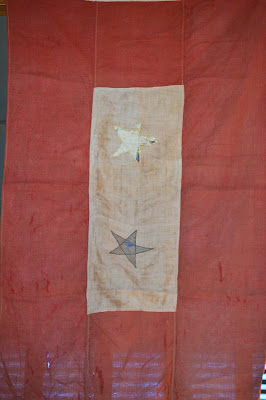
It's a Gold Star Mothers Flag.
The Gold Star was for Anderson Machine Gun Company Private Victor St. Clair Minor.
He was a Blue Star until early on the morning of Oct. 17, 1918, when he went over the top and disappeared in a bombshell explosion somewhere near the border between Belgium and France.
My grandmother, Olive Patterson Cochrane Minor, sewed the Gold Star over the Blue Star when word came down from the Army that St. Clair had died in action.
She had sewn on the two Blue Stars when both her sons went in and over there.
The top one was for St. Clair, the bottom one was for Charles S. Minor Jr., her older boy.
Charlie was in the cavalry, and came home from the War to End All Wars.
Years later, St. Clair's few remains came home, too, and he was reburied in Anderson.
So on this Veterans Day 2014, I remember Uncle Charlie, who lived into the 1960s, and I think about Uncle St. Clair, who died 28 years before I was born, and I send them my thanks, my respects, my admiration and my salute.
Spec. E-5 John M. Betts Jr.
RA 12816683
U.S. Army Signal Corps, 1969-72

It's a Gold Star Mothers Flag.
The Gold Star was for Anderson Machine Gun Company Private Victor St. Clair Minor.
He was a Blue Star until early on the morning of Oct. 17, 1918, when he went over the top and disappeared in a bombshell explosion somewhere near the border between Belgium and France.
My grandmother, Olive Patterson Cochrane Minor, sewed the Gold Star over the Blue Star when word came down from the Army that St. Clair had died in action.
She had sewn on the two Blue Stars when both her sons went in and over there.
The top one was for St. Clair, the bottom one was for Charles S. Minor Jr., her older boy.
Charlie was in the cavalry, and came home from the War to End All Wars.
Years later, St. Clair's few remains came home, too, and he was reburied in Anderson.
So on this Veterans Day 2014, I remember Uncle Charlie, who lived into the 1960s, and I think about Uncle St. Clair, who died 28 years before I was born, and I send them my thanks, my respects, my admiration and my salute.
Spec. E-5 John M. Betts Jr.
RA 12816683
U.S. Army Signal Corps, 1969-72
Subscribe to:
Posts (Atom)